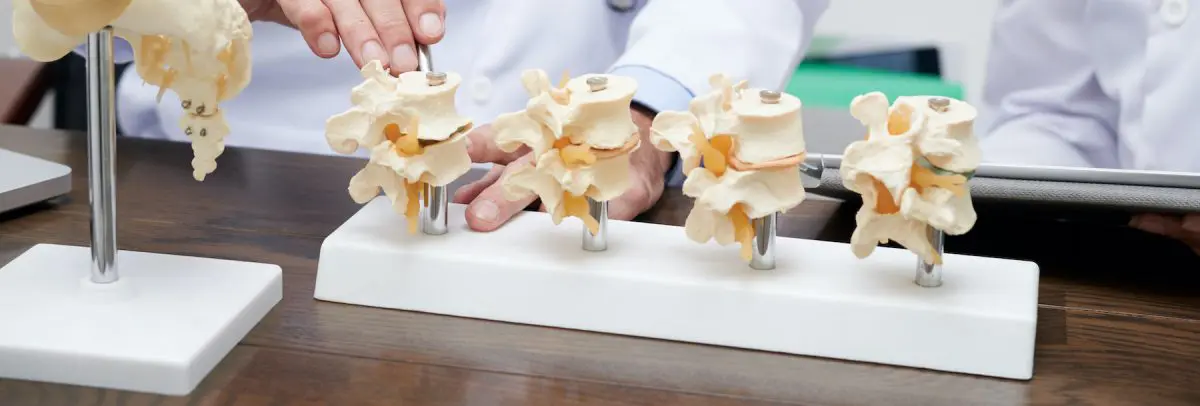
The spine is made up of a series of bones that are stacked on top of each other and are separated by intervertebral discs. These discs are made of a soft mobile center encapsulated by layers of thick fibrous tissue. They are very strong structures that are fused to the tops and bottoms of each vertebrae.
These discs are imperative to allowing movement to take place in the spine. Without them, we would not be able to perform many of the simple rotational and bending movements that are vital to human locomotion. They also are very important for the absorption of forces transmitted throughout the body during all movements, even things as basic as sitting and standing.
The only time that our discs decompress and pressure is taken off of the discs is when we take our body out of gravity, such as when we lay down. When we are no longer vertical and gravity is no longer pressing down on our spine, the discs are able to decompress. This is a vital period as the decompression on the disc material allows for fluid to flow back into this area (instead of being pressed out while holding up the weight of your body) and they will “rehydrate”. This exchange of fluid allows for nutrients to enter into this area and for healing to occur.
 There are a number of reasons that the disc may degenerate over time. Some amount of skeletal degeneration is a normal part of aging. This is largely attributed to tissues losing their propensity for retaining healthy fluid balance and circulation as we age. We see this all over the body including the muscle tissue, joints, even the skin, and hair. In the intervertebral discs, we see a decreased ability for the disc to maintain the same level of fluid balance throughout the day. This can mean that they are not rehydrating as fully during our times of rest and an appropriate balance is not being maintained throughout the day. This will change the physical structure of the disc and make it less able to absorb and distribute outside forces throughout the spine.
Jobs and activities that require a lot of bending, lifting, and twisting are also very hard on the spine and can lead to early-onset degeneration of the disc. These activities introduce a lot of “shearing” force to the disc and the spine. Over time, this will cause localized inflammation to the attachments of the disc to the vertebrae as well as tearing of the outer fibrous rings of the disc. When this happens, it leads to an increased likelihood of disc bulge or herniation as well as arthritic changes to the vertebrae themselves.
As a disc degenerates, another thing that happens is that the disc height will decrease. This can cause the facet joints (joints of the spine that join each vertebra together) to jam into one another, creating local irritation and inflammation. You may notice that looking up, bending backward or twisting is more painful than other movements.
So, what is your move?
 The best thing for this type of condition is to restore proper motion to the area involved with Degenerative Disc Disease Treatment. As joints degenerate, the bones can begin to grow into each other creating spurs and lips to the edges of the bone. These will impede joint movement if not corrected. A strategy will involve addressing movement concerns and positions that put too much pressure on the disc and joints of the spine. It will also include decompression treatment and likely adjusting the problematic regions as seen fit. Few things are better for this condition than chiropractic.
The end goal is to take a dysfunctional, painful area and make it move to its highest capacity so as to stop or slow the progression of degeneration in the spine. If done properly, the function can be greatly restored and you will get back to the activities you love.
If you have any questions please contact our degenerative disc disease doctor about whether your specific insurance will cover your visit, or what your benefits may be, call us at (865) 229-8796. We’d be happy to discuss any questions you may have.


430 Montbrook Lane Suite 203
Knoxville, TN
37919
Phone: 865-337-5574
Monday
7am-12pm & 1pm-6pm
Tuesday
7am-12pm & 1pm-4pm
Wednesday
7am-1pm
Thursday
7am-12pm & 1pm-6pm
Friday
7am-12pm & 1pm-4pm
Saturday & Sunday
Closed