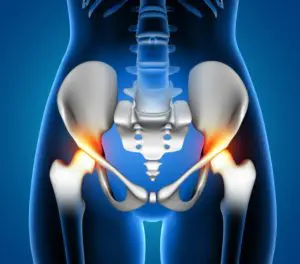
Many people suffer from pain and problems in their hips. Some of the issues people may experience with their hips are pain, limited range of motion, clicking/popping, pain that may radiate up into the back or down the leg, numbness, tingling, or swelling. The most common hip conditions that hip pain treatment in Knoxville, which our chiropractors and physical therapists treat here at Knoxville Spine and Sports are tight hip flexors, impingement, sciatica, bursitis, tendinitis, and hip dysplasia.
Hip pain can be caused by a variety of factors, including injuries and chronic illnesses. Some of the most common causes and symptoms of hip pain are listed below.
Tight hip flexors can be caused by many different things but in our current society, most often it is caused by sitting too much and poor posture. Certainly, traumatic incidents that cause damage to certain tissues of the hip will also result in a loss of motion.
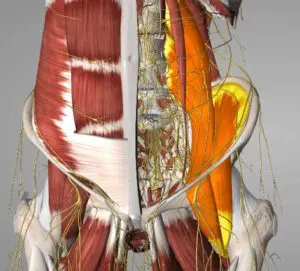
With a loss of motion in the hips, the muscles of the hip will shorten, which is more than likely the cause of the tightness. The most common symptoms of tight hip flexors are groin pain, sometimes pain in the lower back, limited motion, swelling, popping, and clicking. Our chiropractors and physical therapists treat these symptoms and causes through manipulations of the hip and surrounding joints along with dry needling, a form of stretching known as the active release technique, and instrument-assisted soft tissue mobilization.
Hip impingement can be caused by two things. The first is if the head of the femur is misshaped, and the second is if the socket part of the hip joint is too deep. With these two abnormalities in the hip, some of the soft tissue around the joint can become entrapped or pinched with movement.
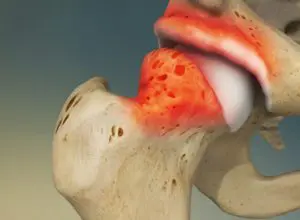 The most frequently experienced symptoms with a hip impingement are stiffness, decreased mobility, and pain in the hip with or without activity. Sometimes pain can be present in other areas than the hip such as the groin or the lower back. The pain comes on most often after the hip has been in a flexed position for a long period such as with sitting, but also with bouts of forceful hip flexion such as with squatting, leg press, deadlift, etc. We treat these problems by using deep soft tissue mobilization, adjustments to the hips and surrounding joints, stretching (ART), hip pain exercises to strengthen the hip extensors, and dry needling.
Sciatica is caused by compression of any part of the sciatic nerve be it where it comes out of the spine or further down the chain. Compression at the level of the spine can be due to a herniated disc, which is when the soft inside of the disc begins to push out of the tough outer layer and into the nerve root that lives just behind it. Spinal stenosis can cause compression on the nerve as well. This is when the holes that the spinal cord runs through (or holes that the nerve roots come out of) begin to narrow, creating less space in the spine where the nerves travel. One other way compression might be present is if there is a bone spur or bony growth on the side of the joint that may begin to press on the nerve. The compression on these nerves can cause many hip pain symptoms such as pain that radiates from the lower back to the hip and down the leg. Other symptoms may be inflammation, numbness, tingling, and muscle weakness. The pain can vary in type, intensity, and location in the hip or leg that it may be felt. 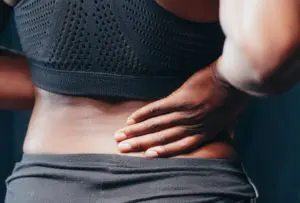 Some things that can cause pain to increase are prolonged sitting, sneezing, and coughing. The treatments for this condition change drastically based on the site that the nerve is being irritated but some of the therapies we utilize strengthen and stabilize exercises, dry needling, manual manipulations, stretches, modalities to help decrease inflammation, and ergonomic changes.
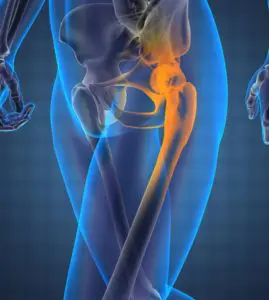 Bursitis is caused by repetitive movements and positions that cause pressure on the bursae around the hip joint. Bursae are tiny little sacs that are filled with fluid to provide a cushion and a gliding movement to decrease friction in joint surfaces. When these bursae become inflamed there is pain around the hip and down the outer thigh that is increased with prolonged walking, an increased amount of squatting, stair climbing, lying on the affected hip, and standing up after sitting for a while. The most common hip bursitis treatment that helps relieve the symptoms and correct the condition of bursitis are stretching, strengthening, adjustments, and modalities to manage and reduce inflammation.
Tendinitis is caused by an inflammation of the tendons in and around the hip most commonly due to overuse.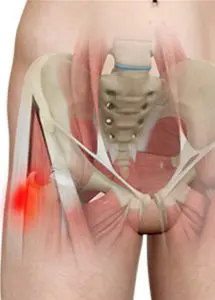 This inflammation from overuse can be caused by high-intensity sports or exercise, running, bicycling, and swimming. Symptoms that you may experience with tendinitis are a limited range of motion, pain in the front of the hip, and swelling. We treat this by using modalities to decrease inflammation, dry needling, adjustments, and strengthening exercises.
As your Knoxville chiropractor, we can help you with a variety of hip pain treatments without surgery. The following are some of the treatments:
Chiropractic adjustments are used to relieve pressure on body parts such as the hip. Chiropractic care for the hips promotes healing by affecting the nervous system through joint dysfunction correction. This promotes healing and can help patients recover more quickly from injuries.
Our physical therapy clinic in Knoxville specializes in treating a wide range of health-related issues and injuries. Each patient is given a thorough assessment and hip pain treatments without surgery. Their progress is monitored at each visit to ensure that they receive the best treatment for their problem.
If you find yourself having any of these symptoms Knoxville Spine and Sports is the place to get help and treatment by either one of our chiropractors or physical therapists. They will take you through an initial evaluation and make up a care plan to help you become pain-free and regain your strength and mobility.

8029 Ray Mears Blvd, Suite 300
Knoxville, TN
37919
Phone: 865-337-5574
Monday
7am-12pm & 1pm-6pm
Tuesday
7am-12pm & 1pm-4pm
Wednesday
7am-1pm
Thursday
7am-12pm & 1pm-6pm
Friday
7am-12pm & 1pm-4pm
Saturday & Sunday
Closed