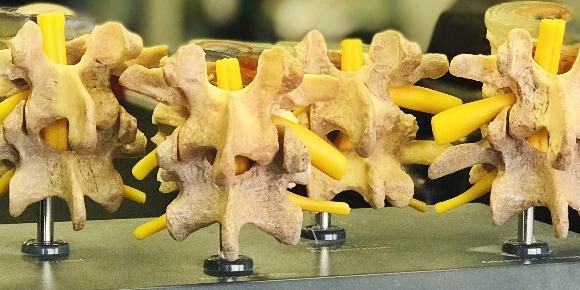
Spinal discomfort can prove disruptive to everyday activity for patients of all ages. With a legion of information and sources at your disposal it can be easy to confuse and misdiagnose ailments. However, we hope to clarify some of the most common spinal injuries as well as the treatment methods we can institute in order to get you back to full health.
In this two-part blog series, we will briefly dive into some of the most common diagnoses you may have received in regards to your spinal suffering. We will first define the terminology and will then discuss methods of treatment we can provide as a multi-disciplined sports medicine office.
Let’s start with the terminology. Spondylosis, spondylolysis, spondylolisthesis, and spinal stenosis are some of the most common diagnoses you may have encountered. These terms are easy to confuse. After all, when receiving any sort of diagnosis, the terminology can be very overwhelming.
The word spondylosis derives from the Greek word for vertebrae. Spondylosis refers to any degenerative changes in the spine such as arthritic changes in the intervertebral discs. These changes are often referred to as osteoarthritis and can include mild arthritis, vertebral disc degeneration, disc bulges or herniations, to name a few. For example, “spondylosis of the lumbar spine” refers to degenerative changes in the vertebrae and/or vertebral discs of the lower back.
As we age, the vertebrae and vertebral discs that create our spine often develop general wear and tear. These discs can become dehydrated and lose height, spinal ligaments can become less elastic, and bone spurs can also develop as an effort made by the body to try and stabilize the spine. The rate of acceleration of such symptoms can be impacted by age, occupation, self-care/preventative measures, injuries, or even genetics.
Because the term “spondylosis” refers to a wide array of spinal diagnoses, the symptoms can vary largely from no pain at all to numbness and tingling in upper and/or lower extremities. Sometimes symptoms include localized ache or tenderness as well as decreased range of motion. In more severe cases, symptoms may include radiating numbness or tingling as a result of compressed nerves.
Spondylosis can occur through the cervical, thoracic, or lumbar section of the spine. Cervical and lumbar spondylosis are most common.
Spondylolysis is a crack or stress fracture that develops through the pars interarticularis. This is the small, thin portion of the vertebrae that connects the upper and lower facet joints. Often, these fractures present in the lower lumbar and can occur on one or both sides of the bone.
The lower lumbar portion of the vertebrae is the weakest portion of the spine. Therefore, it is the area most vulnerable to injury from repeated stress of overuse. Spondylolysis can occur in people of all ages, but children and young adults are often the most susceptible due to the ongoing development. Spondylolysis is more common among athletes as well, often due to repetitive movements, injuries, or increase in training.
If a spondylolysis is not correctly identified or managed, there is a possibility the affected area will heal incorrectly. This could result in the continued stress on the joint and surrounding cartilage that can lead to actual slippage of the vertebrae, thus causing a spondylolisthesis.
Spondylolisthesis is the separation of the fractured pars interarticularis forcing the injured vertebrae to shift or slip forward on the vertebrae below it. This separation weakens the vertebrae and can lead to an inability to maintain its proper position in the spine.
Much like spondylolysis, spondylolisthesis is most common in children and adolescents, particularly during periods of rapid growth.
The relationship of spondylosis, spondylolysis, and spondylolisthesis are all indicative of a worsening spinal condition. However, spinal stenosis falls under a different category of spinal injury though it is equally diagnosed and treated.
"Stenosis” means the abnormal narrowing of a body channel. Spinal stenosis is the narrowing of the channel occupied by the spinal nerves or spinal cord. Occasionally people are born with a congenital form, but most develop spinal stenosis as a result of the degenerative aging process. While some are unaffected by this abnormality, most patients begin to experience symptoms as they age. These symptoms can include radiating pain, weakness and/or numbness and come as a result of the compression of nerves in the spinal cord.
We hope our insight into the terminology and symptoms of the differing spinal ailments will help you better understand your condition. In our next blog post we will begin to discuss the many methods of treatment and their outcomes as we treat for our patients.
Until then,
We are Together For Health!
Sources used and for more detailed information:
https://orthoinfo.aaos.org/en/diseases--conditions/spondylolysis-and-spondylolisthesis/
https://www.mayoclinic.org/diseases-conditions/cervical-spondylosis/symptoms-causes/syc-20370787
https://www.emedicinehealth.com/spondylosis/article_em.htm
https://www.spine-health.com/conditions/spinal-stenosis/what-spinal-stenosis


430 Montbrook Lane Suite 203
Knoxville, TN
37919
Phone: 865-337-5574
Monday
7am-12pm & 1pm-6pm
Tuesday
7am-12pm & 1pm-4pm
Wednesday
7am-1pm
Thursday
7am-12pm & 1pm-6pm
Friday
7am-12pm & 1pm-4pm
Saturday & Sunday
Closed